Archive for the ‘Recorder’ Category
Defects in online “official” public records
Have you had the experience of searching an online court or Recorder index and getting a false negative? You know the name is there but it isn’t returned in your search results. Worse yet, you don’t know whether the record is there and assume it’s not because the site returned “no result.”
I was searching multiple names at the Alameda County Recorder Real Property index and found that results were returned only when the first name listed in a document was searched, but not the second name, even when that name was listed in the index. This only applies to shared last names, I believe.
I queried the name “Bennett, Lyle”, which returned a record in which that name was listed first. The index record for the document shows a second name, “Bennett, Doris.”


I searched the index for “Bennett, Doris” and received a “no record” message.

I’m sure the Recorder would like to hear from you about this glitch. I contacted the provider of the software and received an email directing me to resolve the problem with the Recorder.
What’s your experience searching online records?
Wildcard your county public record searches
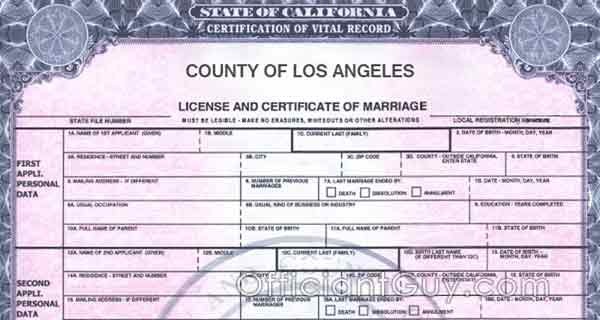
Few counties in California have vital records indexes online. To search for a birth, death or marriage you have to go to the county Recorder where the document was filed. Counties have each of these indexes in various formats: books, microfilm, microfiche and computer. This tip applies to the computer searches.
I previously mentioned online government public record indexes at PIbuzz that you can search using various wildcard symbols with partial company or personal names.
Some databases won’t return results if you enter a partial first or last name or if you only enter one or the other. But sometimes you may want to do a less restricted search of a marriage index. For example, you may know the first name of the bride and want to find all men who married a woman with that first name. Or you only have the last name for the groom and you want to find all records, without having to enter a first name. I’ve faced this situation when I’m doing genealogical searches for pension beneficiaries, heirs in probate cases or just trying to find someone or update their name. Sometimes my information is so dated that there’s no link between that and and the content in proprietary databases — such as those that have credit headers, historical phone listings and court records.
Try this next time you’re searching the birth, death or marriage index at the county Recorder’s onsite computer. Enter the first or last name in the designated field and put two percentage symbols (%%) in the other field. I tried this recently at the San Mateo County Recorder and it worked perfectly.
Do you have a tip for wildcard searching public records?
Public records and newspaper databases – Are they what you think they are?
Words of caution when you’re searching public records online:
Online repositories of official records may not be what you think they are.
Washoe County is one of those rare government agencies that has its Marriage Index online. They’re nice people over there. I had a friendly chat with the records supervisor because I wondered why the date of marriage for a couple was recorded as 2001 when the groom had died in 1984. I’m quick on my feet. There was a really good explanation but it wasn’t on their website so you wouldn’t have known it without talking to her.
The county records generated in the paper-only era, before a computer system was operational (1982), suffered a Y2K-like hiccup when they were entered into the computer. The dates of marriage applications filed prior to December 1983 are incorrect, unless they’ve been manually adjusted, which happens if the discrepancy comes to a staff person’s attention. Yet another reason why it’s still worth talking to people. The electronic record date was 2001 but the actual date of the application was 1948.
When in doubt, verify, nicely
Searching Florida recorded records? If you access these through myfloridacounty (a private site) to search multiple counties at one portal, first select the link “Click here for counties current range of dates.” In yet another friendly chat, I found out that 1. The date range for their records is more limited than that at the government county site; 2. The county doesn’t necessarily send the private site every type of record that is in the official Recorder’s index; and 3. Not all Florida counties participate.
Is blue always blue?
Google Archive News includes newspaper sources aggregated by NewsBank but not all content within those sources is indexed and not all NewsBank newspapers are included in Google News. I don’t know if that is written somewhere by an official source but that’s my experience. Your local library NewsBank database may have content more relevant to your search, and it’s free, searchable, with remote access. Also collect library cards from other regions so you can use their area-specific resources.
Support (with money) organizations that advocate for open records or the government may privatize their maintenance – potentially removing the “public” from public records.
This week in public records: Massachusetts – Illinois – Washington
Town registrars in Massachusetts publish an annual “street list” of local resident names, dates of birth, occupations, veteran status and nationality, which has been a public record. A state Senate bill would change that status, from one of a public record, to one that is only available for federal, state and local governmental use. [Story: Public listings could go private, Matt Murphy, Eagle Boston Bureau]
The common practice of treating search warrants as public records comports with the law, according to an Opinion issued by the Illinois Attorney General. Once the warrants have been returned to the court they are part of the court record and must be available for public inspection.The Sangamon County State’s Attorney backed the Circuit Clerk, who was apparently one of the few court clerks denying the public access to the executed search warrants. As one of this story’s commentators noted, “at some point they have to be made public because it is the public’s dollars which finance them. Making it clear that every search warrant will eventually become public keeps those issuing them honest. We do want judges issuing them and police seeking them kept honest don’t we?”
A Washington State school district narrowly won support from the state Supreme Court in a decision that pitted the Public Records Act against attorney-client privilege for government agencies. Perhaps most damaging to open government, noted in the Justices’ dissent, is the aspect of the ruling allows agencies to seek a judicial determination as to whether a requested public record must be disclosed.
Database of the Day: Oklahoma Multi-County Recorder Search
This is the only site I’ve seen that aggregates the indexes of Recorder documents of multiple counties. The Oklahoma County Clerk Public Records is a project of the Oklahoma county clerks in conjunction with Kellpro, which develops software applications for Oklahoma and Texas county and state agencies. Search across all 28 Oklahoma counties that are currently in this database by name. Registration is free but required to get online access to document images.
This week in public records: Missouri – Tennessee – New York – North Carolina
The Missouri Attorney General has unveiled a database of filed consumer complaints that can be searched by company name or partial name.The database includes more than 100,000 complaints filed since January 1, 2004. View the complaint number, type of complaint, the number of complaints and the date filed. The site does not provide any information on whether the complaint was pursued by the Attorney General or what the result of any investigation might have been.
The Tennessee Sexual Offender Registry has been expanded to include mapping and photographs of all offenders, and more offenders than were previously on the Web site. Registry of sex offenders expanding, Chattanooga Times Free Press, July 27, 2007.
In advance of any state law, the Rockland County, New York Clerk has installed software that will remove Social Security numbers from the online version of recorded documents. According to this article, New York state tax liens now use a different number than the Social Security number on documents.
A bill signed by the governor of North Carolina will marginally facilitate the reconnection of birth parents and the children they relinquished for adoption. If both parties agree, the adoption placement services will act as confidential intermediaries, providing the birth parents and adult children with each other’s contact information.